
Our Patron Saint
St James The Brother of The Lord
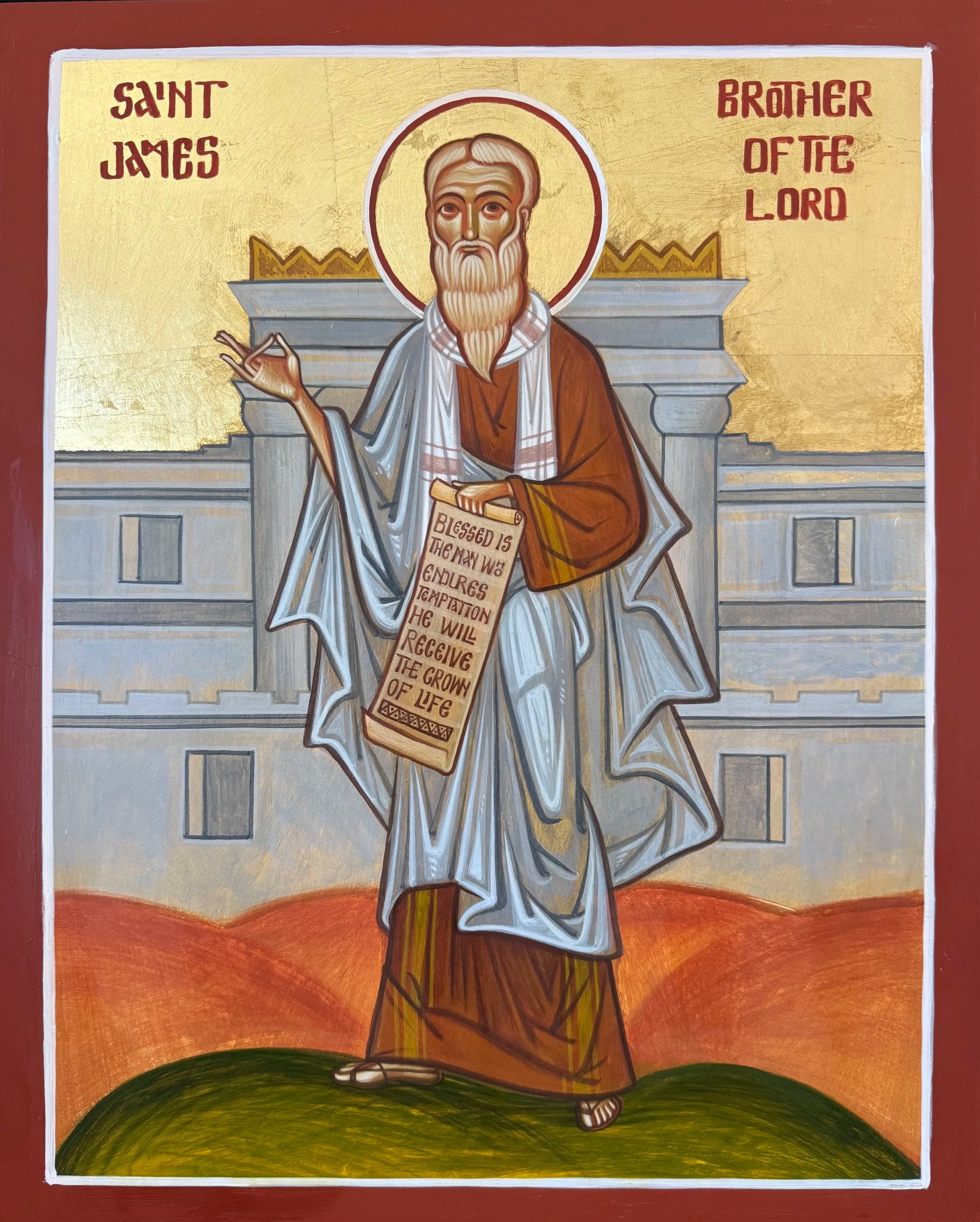
Icon written by Kyrollos Sharobim
According to Coptic Orthodox tradition, St. James is the son of Alphaeus (Clopas). Clopas is the brother of St. Joseph the Betrothed. He is identified with the Clopas who met the risen Lord on the road to Emmaus (Luke 24:18).
His mother, Mary the wife of Clopas, is honored among the Myrrh-Bearing Women. She stood at the foot of the Cross during the crucifixion (John 19:25). Because she was married to Joseph’s brother, she is considered the sister-in-law of the Theotokos and thus is called the “sister of Mary.” The Gospels identify her as the mother of James, Joses, Simon, Jude, and Salome (Mark 6:3; 15:40). St. James is the cousin of the Lord, and therefore is called in Scripture the “brother of the Lord.”
In the Gospels he is known as James the Less, distinguishing him from St. James the son of Zebedee (James the Great). Because of his holiness, prayer life, and asceticism, he was also called James the Just.
Apostolic Ministry
St. James was counted among the Twelve Apostles, as confirmed by St. Paul when he visited Jerusalem:
“I saw none of the other apostles except James, the Lord’s brother.”
Galatians 1:18–19
He accompanied the Lord during His earthly ministry, witnessed His teachings, and received the Holy Spirit on Pentecost together with the Apostles.
Following the day of Pentecost, St. James was chosen as the first Bishop of Jerusalem, the Mother See of Christianity. His leadership earned him respect both among the Jews and among the early Jewish converts to Christ.
Leadership and Writings
St. James presided over the Council of Jerusalem (AD 50), which addressed whether Gentile converts were required to follow Jewish practices to enter the Christian faith. He delivered the council’s final word, affirming the inclusion of the Gentiles without the full requirements of the Law (Acts 15).
He is the author of the Epistle of St. James in the New Testament. St. Paul refers to him as one of the pillars of the Church who extended fellowship to Paul and Barnabas (Galatians 2:9).
Martyrdom
St. James served as bishop for nearly thirty years. His influence led many Jews to embrace the Christian faith, provoking the anger of the chief priests, scribes, and Pharisees. He was seized, taken to the pinnacle of the Temple, and asked to deny the Lord. When he refused, he was thrown down and martyred near the Temple.
Thus, he received both the crown of apostleship and the crown of martyrdom.
The Contributions of St. James
The Principal of Synodality
When the issue arose of whether the Gentile Christians needed to be circumcised to be part of the Church, it seemed as if this would damage the Church irreparably. So the leaders of the Church gathered in Jerusalem to discuss a solution. Being the Bishop of Jerusalem St. James presided over the council and after hearing the considerations from all sides, he rendered his historic verdict. This was unanimously accepted by all gathered at what would later be called the Jerusalem Council. Since then, the Church has always solved her issues in the same manner, through the gathering of her bishops in Synods and Councils. The wonderful statement by St. James, “It seemed good to the Holy Spirit and us,” is the belief of the Church even today, that the Holy Spirit always speaks through the Bishops and leaders of the Church whenever they gather together.
Liturgy & Church Order
Leading the early Church during a time when her doctrines and worship practices were still taking shape was no simple task. Rising to this responsibility, St. James helped develop one of the earliest Christian liturgies. This Liturgy became the foundation for all later liturgical traditions. The Liturgy of St. James continues to be celebrated in many Orthodox Churches to this day.
His Epistle
The epistle of St. James stands as one of the most practical and spiritually rich books of the New Testament. Often called the “Proverbs of the New Covenant,” it offers clear, compelling guidance for living an authentic Christian life. St. James emphasizes the inseparable relationship between faith and works, reminding believers that true faith expresses itself in righteous action, compassion, and purity of heart. His teachings on humility, endurance in trials, control of the tongue, and care for the poor provide timeless wisdom that continues to guide the Church today. With its straightforward call to holiness and integrity, the epistle remains a treasured roadmap for believers seeking to embody the Gospel in daily life.
May the prayers and blessings of this great saint be with all.